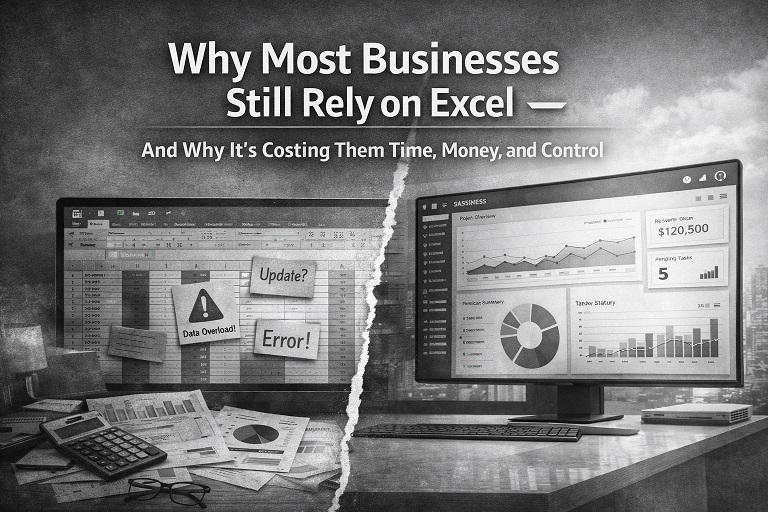
Many companies still manage their operations using Excel sheets, emails, and manual tracking. At first, this seems practical and inexpensive. But as the business grows, these tools become the reason for delays, mistakes, data loss, and poor decision-making.
What most businesses don’t realize is that the problem is not the people or the workflow — it’s the absence of a proper business system.
In this article, we explain why Excel becomes a limitation, and how custom dashboards, management systems, and automation tools completely change the way a company operates.
The Excel Trap
Excel is great for calculations.
It is terrible for business management.
Here’s what usually happens:
- Multiple versions of the same file
- Data stored on personal laptops
- No central database
- Manual reports that take hours
- Human errors in formulas
- No user roles or permissions
- No real-time visibility for management
As operations grow, Excel turns from a solution into a bottleneck.
What a Business System Changes
A custom business system built with a database (PHP & MySQL for example) replaces all of this with:
- A central dashboard accessible from anywhere
- Structured data stored securely
- Automatic calculations and reports
- User roles (admin, staff, management)
- Real-time tracking of projects, payments, policies, costing, or clients
- Searchable history and reporting
- No duplicate files. No confusion.
Instead of managing files, you start managing your business.
Real Examples of Systems Businesses Need
Different industries need different systems:
- Engineering companies need costing dashboards, project tracking, and BOQ management
- Insurance brokers need policy management, payment tracking, and client records
- Trading businesses need performance dashboards and reporting tools
- Service companies need task tracking, client history, and automated reporting
All of these are impossible to manage efficiently with spreadsheets.
Dashboards: The Missing Piece for Managers
Managers don’t need files.
They need visibility.
A dashboard shows:
- What is happening now
- What is delayed
- What is paid and unpaid
- Performance indicators
- Financial summaries
- Team activity
In seconds — not hours of manual preparation.
Automation Removes Human Error
When calculations, reports, emails, and updates are automated:
- Mistakes disappear
- Time is saved
- Staff focus on work instead of paperwork
- The business becomes scalable
This is where automation tools make the biggest difference.
It’s Not About a Website — It’s About a System
Most developers build websites.
Very few build systems.
A system is designed around how your business actually works, with real logic, real data, and real workflows.
That’s the difference between a website and a business platform.
Conclusion
If your company still relies on Excel sheets to run daily operations, you are not alone — but you are also not operating at your full potential.
Replacing spreadsheets with a custom business system and management dashboard is one of the biggest upgrades a company can make in efficiency, control, and growth.
And the good news? It doesn’t require changing how you work.
It simply requires building the right tool around your workflow.