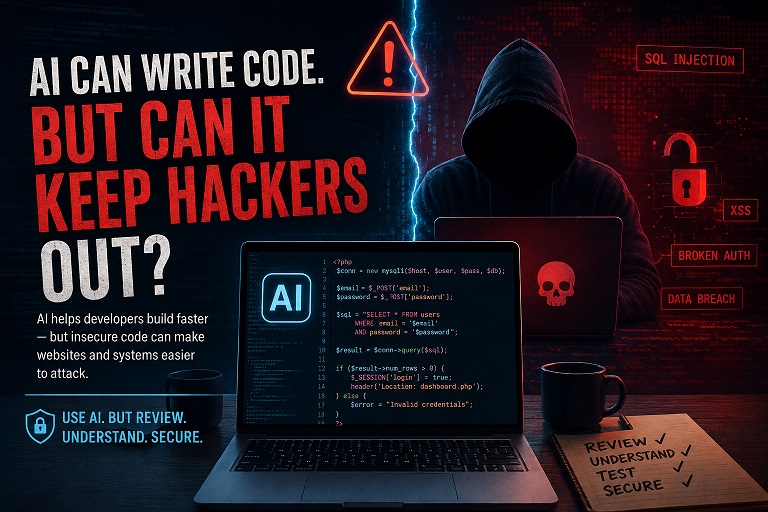
Artificial intelligence has changed software development dramatically.
Today, a developer can describe a feature and receive working PHP, JavaScript, Python, SQL, or API code within seconds. Tasks that once required hours of research, documentation, testing, and debugging can sometimes be completed in minutes.
AI has made developers faster.
But there is an uncomfortable question the development community needs to discuss:
Is AI also making some websites and systems easier to attack?
The answer isn't simply yes or no.
The real problem begins when developers stop treating AI as an assistant and start treating it as the developer.
AI Can Write Code. It Doesn't Understand Your Entire System.
Imagine asking an AI:
"Create a PHP login system with an admin dashboard."
Within seconds, you may receive a complete login form, database queries, sessions, password handling, and an admin page.
It looks professional.
It works.
So the developer uploads it.
But working code is not necessarily secure code.
The generated solution may not fully understand your server configuration, database structure, authentication architecture, hosting environment, existing application, user permissions, or security requirements.
A vulnerability doesn't need to break the website.
The website can work perfectly while still containing a serious security weakness.
The Copy-Paste Development Problem
AI has created a new type of development workflow:
Prompt → Copy → Paste → Upload → Done
That workflow is dangerous.
Before AI, developers commonly searched documentation, Stack Overflow, GitHub, technical articles, and framework documentation.
That process wasn't perfect either, but developers often had to understand enough of the problem to combine different pieces into a working solution.
Now an AI can generate hundreds of lines of apparently finished code instantly.
This creates a temptation to skip the most important question:
"Do I actually understand what this code is doing?"
If the answer is no, deploying it to production can become a security risk.
Attackers Have AI Too
There's another side of the story.
Developers aren't the only people using artificial intelligence.
Attackers can use AI-assisted tools to understand applications, analyze code, automate reconnaissance, identify suspicious behavior, and accelerate parts of their workflow.
So we are entering an interesting cybersecurity race.
AI helps developers build faster.
AI can also help attackers move faster.
That makes secure development practices even more important than before.
Is AI Code Predictable?
There is a common misconception that hackers can simply recognize that a website was created using ChatGPT or another AI and immediately know how to hack it.
Cybersecurity doesn't usually work that way.
An attacker normally doesn't need to know whether your code was written by a human, AI, an agency, or an internal development team.
They look for weaknesses.
For example:
- SQL injection
- Cross-site scripting (XSS)
- Broken authentication
- Weak authorization
- Exposed API keys or credentials
- Insecure file uploads
- Missing CSRF protection
- Improper session management
- IDOR and access-control problems
- Debug information exposed in production
- Outdated dependencies
- Poorly protected admin endpoints
If AI-generated code contains one of these weaknesses, attackers can potentially exploit it just like any other vulnerable code.
The problem isn't that "hackers know AI's code."
The problem is that large amounts of similar, insufficiently reviewed code can create familiar vulnerability patterns.
A Dangerous Example: "Make an Upload Page"
Consider a developer asking AI:
"Create a page where users can upload profile pictures."
AI generates the page.
The developer tests it.
A JPG uploads successfully.
Everything appears to work.
But did the developer check:
What file types are actually accepted?
Is validation based only on the filename extension?
Can executable files be uploaded?
Are uploaded files stored inside a publicly executable directory?
Is the MIME type validated?
Are filenames randomized?
Is there a file-size limit?
Can one user overwrite another user's file?
The feature may take five minutes to build.
Properly securing that feature may require significantly more thought.
This is exactly where AI-assisted development becomes dangerous when speed replaces engineering discipline.
Authentication Is Another Example
Ask an AI to generate:
"A login system with admin and user roles."
It may produce something that works immediately.
But authentication security involves much more than checking an email address and password.
A production system may need:
- Secure password hashing
- Session regeneration
- CSRF protection
- Rate limiting
- Brute-force protection
- Secure cookies
- Permission checks on every protected endpoint
- Password-reset security
- Proper logout/session invalidation
- Audit logs
- Multi-factor authentication for sensitive systems
AI may implement some of these.
It may implement all of them.
Or it may implement them incorrectly for your particular application.
The developer remains responsible for knowing the difference.
The Biggest Risk Isn't AI. It's False Confidence.
This may be the most important point.
AI-generated code often looks convincing.
It is formatted correctly.
Functions have professional names.
Comments explain what is happening.
The application runs.
The interface works.
And that creates confidence.
But cybersecurity vulnerabilities are frequently invisible to the person using the application.
A button working doesn't prove the authorization behind that button is secure.
A login succeeding doesn't prove sessions are protected correctly.
A file uploading doesn't prove the upload mechanism is safe.
A database query returning results doesn't prove it cannot be manipulated.
Functionality and security are two different tests.
AI Is Still an Incredible Tool for Developers
None of this means developers should stop using AI.
That would be the wrong conclusion.
AI can be an extraordinary development tool.
It can help developers:
- Generate boilerplate
- Explain unfamiliar code
- Debug problems
- Write tests
- Review functions
- Suggest security improvements
- Understand documentation
- Refactor legacy code
- Identify potential vulnerabilities
- Prototype ideas quickly
The difference is how it is used.
Bad workflow:
Ask AI → Copy → Upload
Better workflow:
Ask AI → Understand → Review → Test → Security Test → Deploy → Monitor
That difference matters.
Developers Need to Become Reviewers, Not Just Prompt Writers
AI is changing what it means to be a developer.
Writing every line manually may become less important.
Understanding architecture, databases, authentication, networking, permissions, APIs, security, testing, and infrastructure may become even more important.
Because when AI produces 500 lines of code in seconds, somebody still needs to answer:
Should these 500 lines be running on a production server?
That person is the developer.
AI Doesn't Remove the Need for Developers
There is an irony in the current AI revolution.
Some people believe AI means businesses won't need experienced developers anymore.
Cybersecurity demonstrates why that assumption is dangerous.
Generating code is only one part of software engineering.
Professional development also involves:
Architecture. Security. Testing. Performance. Scalability. Maintenance. Monitoring. Backups. Recovery. Access control. Business logic.
AI can assist with all of these.
But assistance and responsibility are not the same thing.
The Future Isn't AI vs. Developers
The future will probably not belong to developers who refuse to use AI.
And it won't belong to people who blindly copy everything AI generates.
It will belong to developers who understand both software engineering and AI.
Developers who can use AI to move faster while still knowing when its answer is incomplete, insecure, inefficient, or simply wrong.
Because the question we should be asking is not:
"Did AI write this code?"
The better question is:
"Who reviewed it before it reached production?"
Final Thought
AI has dramatically reduced the time required to create software.
But it has not reduced the responsibility required to secure it.
If AI allows us to build software ten times faster, our security practices need to evolve just as quickly.
AI can generate the code.
AI can suggest the architecture.
AI can even help find vulnerabilities.
But before that code controls customer information, payments, company data, or business operations, a developer still needs to understand what is running behind the screen.
Use AI to become a faster developer—not a developer who stops thinking.